Dear friend,
I see you. I see you in the way you automatically check the weather before anyone else thinks to ask about jackets. I see you in how you remember not just your own dentist appointment, but everyone else’s too. I see you quietly restocking the coffee filters, updating the shared calendar, and sending the “just checking in” texts that keep your world spinning smoothly.
You’re the one people turn to when things fall apart, and more importantly, you’re the reason things rarely fall apart in the first place. You’ve become the infrastructure—the invisible foundation that everyone else’s life is built on.
But here’s what I want you to know: you weren’t meant to be the infrastructure.
The Weight of Being Essential
There’s a particular exhaustion that comes with being the person who remembers everything. It’s not the satisfying tiredness of physical work or even the mental fatigue of a challenging project. It’s something deeper—the constant low-level hum of responsibility that never quite turns off.
You carry the mental map of everyone’s needs, preferences, and schedules. You know which kid needs their permission slip signed, when the car registration expires, and that your partner gets cranky if dinner is later than 7 PM. You’ve internalized a thousand small details that keep life running smoothly, and somewhere along the way, this became your identity.
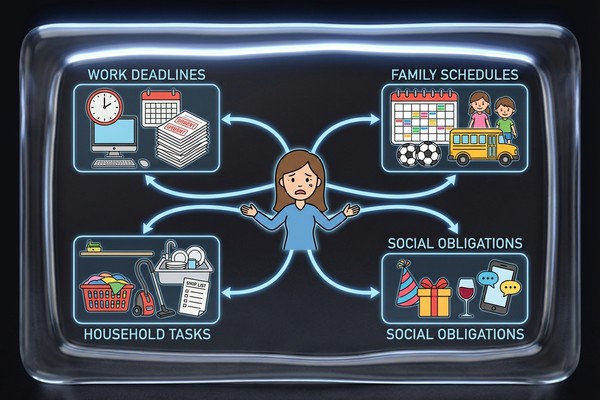
The cruel irony is that the better you get at this invisible work, the more invisible it becomes. When you successfully coordinate a family vacation, people remember the vacation—not the seventeen conversations, four spreadsheets, and countless small decisions that made it possible. When the household runs smoothly, it looks effortless from the outside.
The proof of your work is in what didn’t go wrong.
But you feel it. You feel it in the way your mind immediately jumps to logistics when someone mentions a plan. You feel it in how you can’t fully relax because you’re always scanning for what needs attention next. You feel it in the strange guilt that creeps in when you try to do something just for yourself.
The Hidden Cost of Holding Everything Together
This constant state of readiness takes a toll that’s hard to articulate. You might find yourself snapping at people over small things, not because you’re angry about the dishes in the sink, but because the dishes represent the hundredth small thing you’ve noticed and mentally added to your ever-growing list.
Or maybe you’ve gone the other direction—you’ve become so efficient at managing everyone else’s needs that you’ve lost touch with your own. When someone asks what you want for dinner, you draw a blank. When you have a rare free hour, you spend it organizing something instead of resting because rest feels foreign, almost uncomfortable.
The weight of being essential creates its own trap. People depend on you because you’re dependable, which makes you more essential, which makes it harder to step back. You’ve become so good at anticipating and preventing problems that everyone—including you—has forgotten that this is work.
Breaking the Shame Cycle
Here’s where I need to challenge something that might be sitting heavy in your chest: the idea that needing help means you’re failing.
Our culture has sold us a particularly toxic story about competence. It suggests that truly capable people should be able to handle everything gracefully, that asking for support is a sign of weakness, and that struggling with the mental load means you’re not organized enough or trying hard enough.
This is complete nonsense.
The person who can juggle fifteen different responsibilities isn’t more capable than someone who recognizes that juggling fifteen things at once is an unreasonable expectation. The person who asks for help isn’t weak—they’re wise enough to understand that sustainable systems don’t rely on one person’s heroic effort.
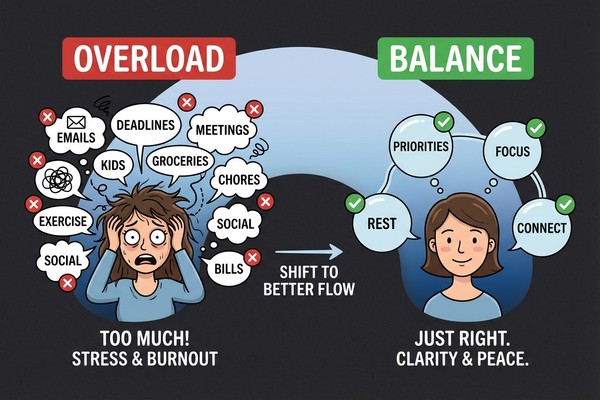
You didn’t volunteer for this role because you’re naturally better at remembering things. You stepped into it because you care deeply about the people in your life, because you have a low tolerance for chaos, or because nobody else stepped up. These are admirable qualities that got weaponized into an impossible job description.
Competence isn’t about carrying everything—it’s about knowing what’s worth carrying.
Permission to Put Something Down
I want to give you permission to drop something today. Not everything, not all at once—just one thing.
Maybe it’s the expectation that you’ll remember everyone’s dietary preferences when ordering group meals. Maybe it’s the assumption that you’ll automatically handle the gift-buying for extended family. Maybe it’s the mental responsibility for keeping track of when household items need replacing.
Pick one expectation that you’ve been carrying and consciously decide not to carry it today. Notice what happens when you don’t automatically step in. Notice if the world actually falls apart, or if someone else figures it out, or if the thing just doesn’t get done and life goes on anyway.
This isn’t about becoming irresponsible or letting people down. It’s about testing whether all the things you’re holding are actually as critical as they feel. Sometimes the most radical act is discovering that your absence creates space for someone else’s presence.
What Would You Hand Off First?
If you could wave a magic wand and transfer just one category of mental responsibility to someone or something else, what would it be?
Would it be the constant awareness of what’s running low in the house—the coffee, the toilet paper, the kids’ school supplies? Would it be the emotional labor of remembering birthdays and maintaining relationships? Would it be the coordination required to keep everyone’s schedules aligned?
There’s no wrong answer here, but there’s power in naming it. When we can identify what feels most burdensome, we can start imagining what relief might look like.
Some of these responsibilities genuinely need to live somewhere. But they don’t all need to live with you. And more importantly, the ones that do stay with you don’t need to live in your head as constant background anxiety.
The Possibility of Support
Here’s what I want you to imagine: What would it feel like to have something actively working to reduce your mental load instead of adding to it?
Not another system that requires you to remember to use it. Not another app that sends you notifications you have to manage. But something that actually takes ownership of outcomes, that follows up on the loose ends, that remembers so you don’t have to.
This isn’t about becoming less capable or less caring. It’s about redirecting your considerable abilities toward things that actually energize you instead of depleting you. It’s about creating space in your mind for thoughts beyond logistics and coordination.
The people in your life love you for who you are, not for your ability to remember their dentist appointments. Your worth isn’t measured by how seamlessly you can manage complexity. You are valuable beyond your utility.
You deserve support that actually supports you, not systems that just reorganize your overwhelm.
A Different Kind of Strength
The strongest thing you can do right now might be admitting that this is hard. That carrying the mental load for multiple people is exhausting. That you’re tired of being the default solution to every coordination problem.
You’ve been strong in the way that keeps everything together. Now it’s time to be strong in the way that creates space for change.
This doesn’t mean everything will shift overnight. The people in your life might need time to adjust to new expectations. You might need time to remember what it feels like to not constantly scan for problems. But change is possible, and you deserve to experience what life feels like when someone else is holding some of the weight.
You weren’t meant to be the infrastructure. You were meant to be a person—complex, deserving of care, worthy of support that doesn’t require you to earn it through perfect execution of invisible work.
The world needs your caring nature, your attention to detail, your ability to see what others miss. But it needs these gifts in sustainable doses, not as an endless stream of self-sacrifice.
You are seen. Your work matters. And you deserve better than a life spent holding everything together while nobody holds you.
With deep respect for all you carry, Someone who understands
This article was created with collaboration between humans and AI—we hope you ❤️ it.