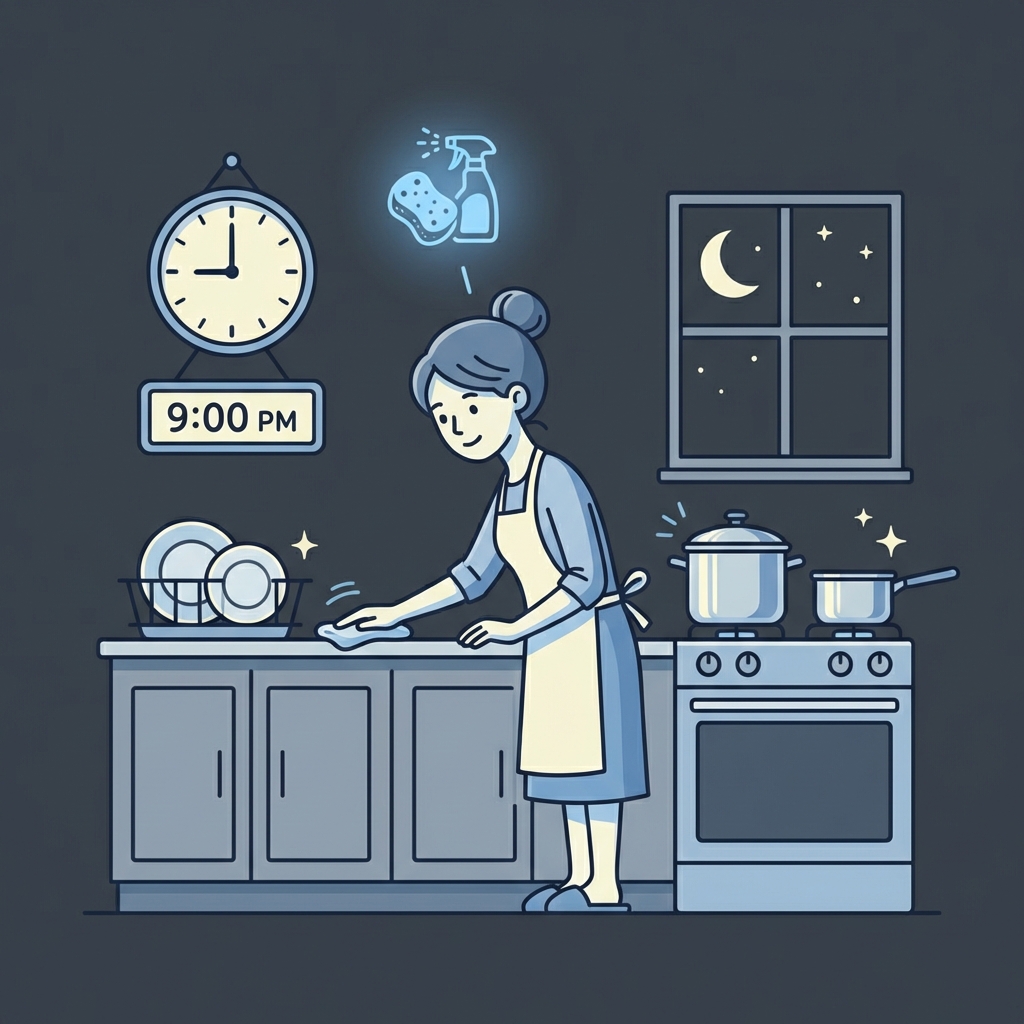
The day is officially over. Dinner plates cleared, homework supervised, bedtime stories read. The house settles into its evening quiet, and most people would call this the end of the workday. But in kitchens across the country, another kind of work is just beginning.
It starts with a survey. Not the kind you fill out online, but the kind you do with your eyes and your tired brain. The coffee maker needs prep for tomorrow. The lunch boxes sit empty on the counter. The sink holds the remnants of dinner, and the dishwasher door hangs open like a question mark. Someone has to answer.
This is the 9 PM kitchen reset—the work that happens after the work, the labor that keeps tomorrow from becoming a crisis before it even starts.
The Choreography of Caring
Watch someone do this reset, and you’ll see a dance of micro-decisions that most people never notice. Each movement is small, but together they form something essential: the infrastructure of a functioning household.
The lunch boxes get filled first—turkey sandwich, apple slices, the snack they actually eat versus the healthy one that comes home untouched. Mental calculation: do we have enough bread for the week? The bananas are getting spotty; add them to the list that lives partly in your head, partly on your phone, partly on the magnetic notepad that no one else seems to see.
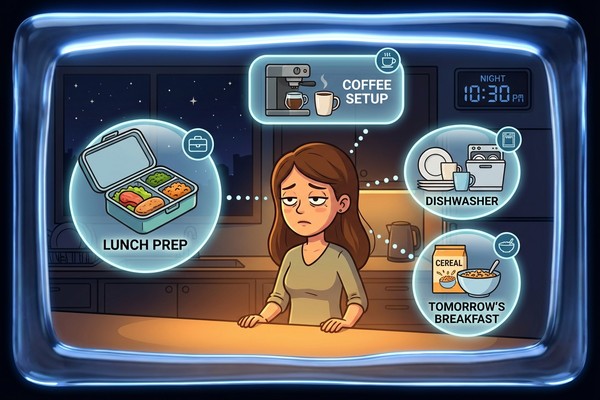
Coffee prep is next. Rinse the carafe, measure the grounds, set the timer. It’s a small kindness to your future self—the difference between stumbling toward caffeine and having it ready when you need it most. The person who does this reset knows that 6 AM you will be grateful, even if 6 AM you won’t remember to say thank you.
The dishwasher gets loaded with a specific logic. Plates here, bowls there, the good knife that can’t go in the silverware basket. Someone taught you this system, or you figured it out through trial and error, and now you do it automatically. The muscle memory of making things work.
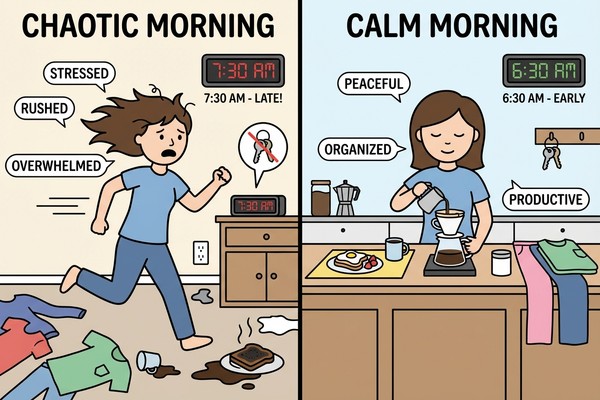
The proof is in what didn’t happen—the morning that flowed instead of fractured.
Each task is small enough to dismiss, important enough to matter. The homework folder goes back in the backpack. The vitamins get set out. The counter gets wiped down, not just for cleanliness but for the psychological relief of starting fresh tomorrow.
What’s Really Being Protected
This isn’t about having a perfect kitchen or winning some imaginary domestic award. The 9 PM reset protects something more valuable: the possibility of an easier morning.
It protects the kids from the stress of scrambling for lunch money or forgotten assignments. It protects the morning routine from devolving into chaos and harsh words. It protects that first cup of coffee from being delayed by yesterday’s dishes.
Most importantly, it protects the person doing the reset from carrying even more mental load tomorrow. Because if these tasks don’t get done now, they don’t disappear—they just move to a time when you’re already juggling too much.
The reset creates what researchers call “cognitive ease”—the mental state that comes from having fewer decisions to make and fewer problems to solve. When tomorrow’s lunch is already packed, when the coffee is already prepped, when the counter is already clear, your brain gets to focus on the day ahead instead of catching up with yesterday.
The Emotional Undercurrent
But let’s be honest about what else lives in this late-night routine: the complex mix of emotions that comes with invisible work.
There’s pride in the competence, in knowing how to make a household run smoothly. There’s satisfaction in the small kindnesses—the way tomorrow-you will smile at tonight-you’s thoughtfulness.
There’s also exhaustion. The bone-deep tiredness that comes from being the person who notices what needs doing and then does it. The weight of being responsible not just for your own tomorrow, but for everyone else’s too.
And sometimes, if we’re being completely honest, there’s resentment. Not at the tasks themselves, but at the invisibility of it all. At being the only one who sees that the lunch boxes need filling, that the coffee needs prepping, that tomorrow needs protecting from tonight’s neglect.
This is operations work disguised as housework, management disguised as chores.
The person doing the 9 PM reset is essentially running a small organization. They’re anticipating needs, managing resources, coordinating schedules, and maintaining systems. In any other context, this would be called operations management or project coordination. But because it happens in a kitchen at 9 PM, it gets dismissed as “just housework.”
The Labor of Anticipation
What makes this work particularly invisible is that it’s largely about preventing problems rather than solving them. The success is measured in what doesn’t go wrong—the morning that flows smoothly, the lunch that doesn’t get forgotten, the coffee that’s ready when needed.
Prevention work is always harder to see and appreciate than crisis management. When someone swoops in to solve a problem, they get credit for being helpful. When someone prevents the problem from happening in the first place, their work disappears into the smooth functioning of daily life.
The 9 PM kitchen reset is anticipatory labor at its finest. It’s the work of thinking ahead, of imagining tomorrow’s needs and meeting them tonight. It requires not just physical effort but emotional intelligence—understanding how stress affects morning routines, how small preparations can prevent big meltdowns, how taking care of the details means everyone else can focus on bigger things.
A Gentle Accounting
So here’s a question worth asking, gently and without judgment: who notices this work in your household? Who carries the mental load of remembering that it needs to happen? Who actually does it?
Maybe it’s shared equally, with family members taking turns or dividing tasks. Maybe it rotates based on schedules and energy levels. Maybe it’s a solo effort by someone who’s gotten good at it, or maybe it’s a source of ongoing negotiation and conversation.
There’s no single right answer, but there’s value in making the work visible. In acknowledging that someone is doing this labor, that it matters, that it makes everyone else’s life easier.
The goal isn’t to create guilt or resentment, but recognition. To see the 9 PM kitchen reset for what it really is: skilled work that keeps a household functioning, emotional labor that protects everyone’s peace of mind, and a form of care that deserves to be noticed and appreciated.
What Support Could Look Like
Imagine if this work didn’t fall to one person by default. Imagine if the mental load of remembering and coordinating was shared, if the physical tasks were distributed, if the emotional labor was acknowledged.
Support might look like a partner who notices when the lunch boxes are empty and fills them without being asked. It might look like kids old enough to prep their own backpacks and set out their own clothes. It might look like family meetings where everyone takes ownership of different pieces of the household operations.
The goal isn’t perfection—it’s partnership in the work of making life work.
Or maybe support looks like technology that actually reduces rather than increases the mental load. Systems that remember so you don’t have to, that anticipate needs so you can focus on bigger things, that handle the coordination work that currently lives in one person’s head.
The 9 PM kitchen reset will probably always exist in some form—there’s something deeply human about preparing for tomorrow, about creating order from the day’s chaos. But it doesn’t have to be invisible work carried by one person. It can be shared work, acknowledged work, supported work.
Because the person doing that late-night reset isn’t just cleaning up from today. They’re building tomorrow, one small task at a time. And that work—quiet, essential, often unnoticed—deserves to be seen for what it truly is: the foundation that lets everything else happen.
This article was created with collaboration between humans and AI—we hope you ❤️ it.