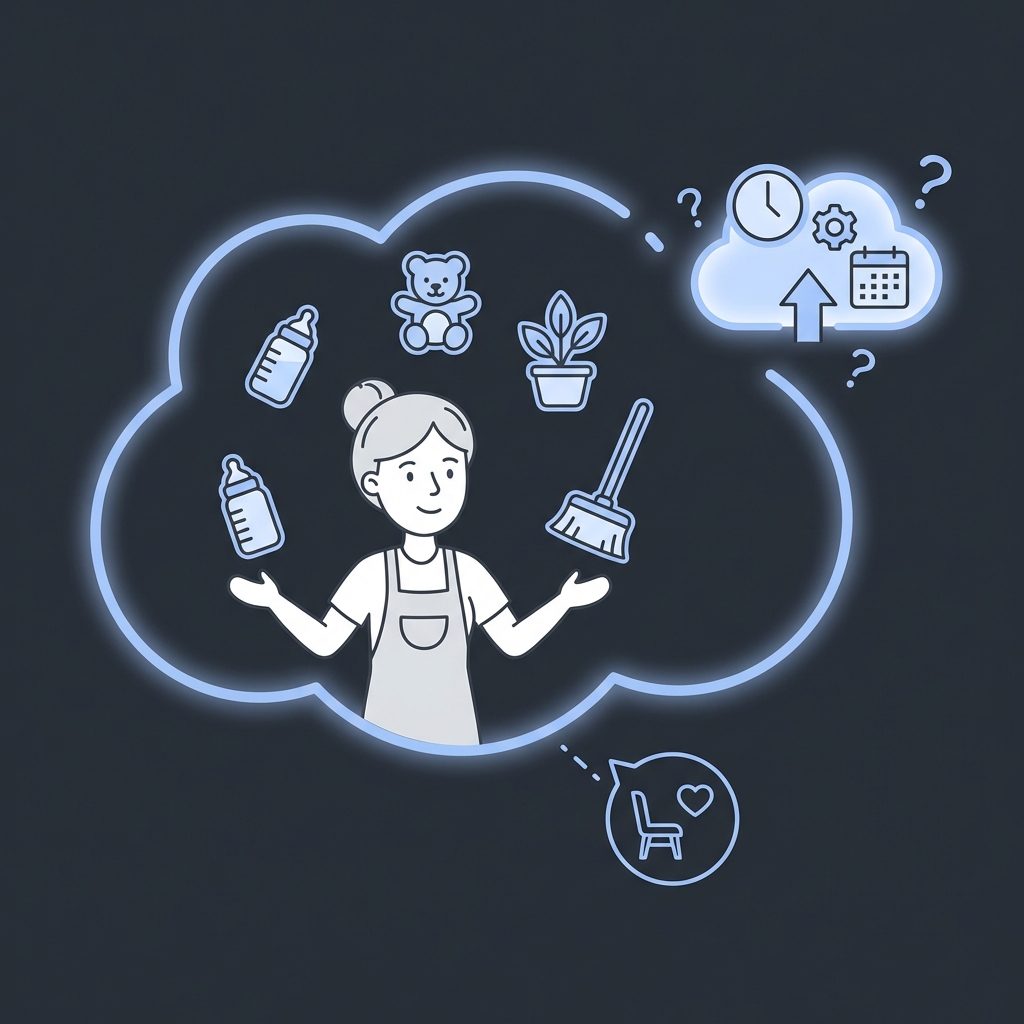
The productivity guru’s morning routine sounds like a fantasy novel. Wake at 5 AM, meditate for twenty minutes, journal with intention, tackle the most important task while the world sleeps. No interruptions, no urgent needs, no one else’s schedule to consider. Just pure, unbroken focus flowing toward optimized outcomes.
If you’re reading this while mentally calculating whether you can squeeze in a grocery run between work calls and pickup time, that fantasy probably feels more like science fiction. The gap between mainstream productivity advice and the reality of caring for other humans isn’t just wide—it’s a completely different universe.
Most productivity frameworks are built on assumptions that simply don’t exist when your life includes care work. And the problem isn’t that caregivers are doing productivity wrong. The problem is that productivity advice ignores half of what keeps the world running.
The Hidden Assumptions of Productivity Culture
Classic productivity advice assumes you control your own time, energy, and priorities. It assumes you can batch similar tasks, minimize context switching, and protect deep work blocks. It assumes that if you just get organized enough, disciplined enough, systematic enough, you can optimize your way to a frictionless life.
These assumptions work beautifully when you’re optimizing a single person’s workflow in predictable conditions. They fall apart completely when you’re responsible for keeping other humans fed, healthy, emotionally regulated, and on schedule.
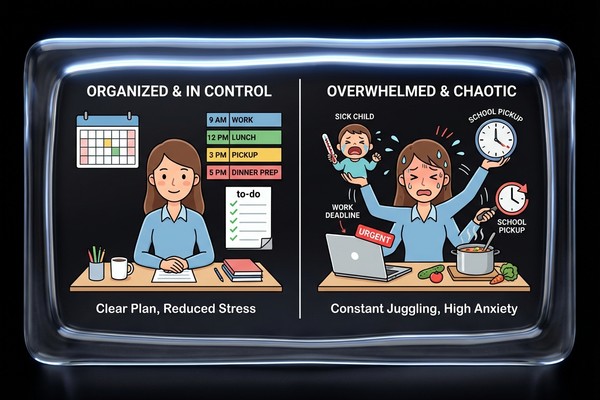
Consider the fundamental assumption of uninterrupted time blocks. The productivity world treats interruptions like contamination—something to be eliminated through better boundaries and communication. But when you’re caring for children, aging parents, or managing a household, interruptions aren’t inefficiencies to be optimized away. They’re the actual work.
A two-year-old doesn’t respect your deep work block. A parent with dementia doesn’t check your calendar before having a crisis. The school nurse doesn’t care about your quarterly goals when calling about a fever. These aren’t productivity failures—they’re human realities that most productivity advice pretends don’t exist.
Why Care Work Breaks the Model
Care work operates on completely different principles than the individual optimization model that dominates productivity culture. It’s inherently relational, anticipatory, and interrupt-driven. You can’t batch feeding a baby or time-block emotional support or automate the work of noticing what someone else needs.
The invisible labor of care work includes constant low-level monitoring—tracking everyone’s schedules, energy levels, and emotional states. It means remembering that your partner has a big presentation Tuesday so you shouldn’t plan anything demanding that evening. It means noticing your child seems off and might be getting sick, which could derail Thursday’s plans. It means keeping a running mental inventory of what’s in the fridge, who needs what, and when everything expires.
Care work doesn’t fit into neat task categories because it’s about maintaining the conditions where other people can function.
This kind of work doesn’t translate well into productivity systems designed for individual contributors. You can’t put “notice if mom seems more confused than usual” on your task list. You can’t time-block “be emotionally available when teenager wants to talk.” You can’t batch “coordinate everyone’s conflicting needs into something that works.”
Most productivity advice treats this invisible work like it’s optional overhead—something that efficient people minimize. But care work isn’t overhead. It’s the foundation that makes everything else possible. When productivity culture ignores it, it’s essentially saying that the work of keeping humans alive and functioning doesn’t count as real work.
The Failure of Time Blocking
The advice to “just time block everything” reveals how disconnected productivity culture is from care realities. Time blocking assumes you control the variables—that you can estimate how long things take, predict when they need to happen, and protect the boundaries you create.
Care work laughs at time blocks. A simple bedtime routine can take thirty minutes or two hours, depending on meltdowns, last-minute homework discoveries, or sudden needs for deep philosophical discussions about death. Meal prep time depends on whether anyone’s having a difficult day, whether the grocery store has what you need, and whether you discover you’re out of a crucial ingredient halfway through cooking.
The unpredictability isn’t a bug—it’s a feature. Good caregiving requires flexibility and responsiveness. The ability to drop everything when someone needs you isn’t poor time management; it’s literally the job. But productivity advice treats this flexibility like a character flaw that better systems could fix.
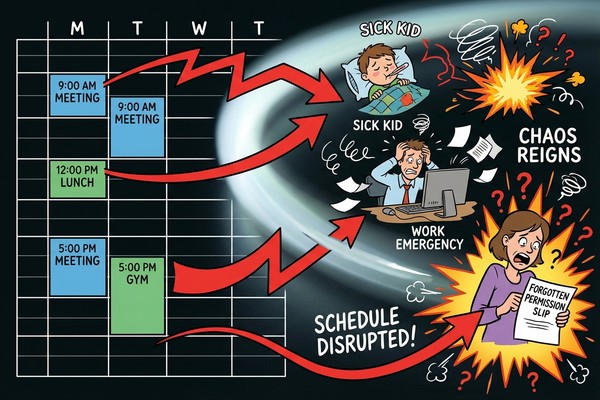
Even when time blocking works temporarily, it often creates more mental load rather than less. Now you’re not just managing the unpredictable demands of care work—you’re also managing the guilt and stress of constantly failing to stick to your optimized schedule.
A Different Framework for Care-Heavy Lives
What if we designed planning systems that assumed care work instead of ignoring it? What would productivity advice look like if it started from the reality that most people are responsible for more than just their own outcomes?
A care-aware approach would build in buffers instead of optimizing them away. It would prioritize flexibility over efficiency. It would recognize that some of the most important work can’t be scheduled, measured, or optimized.
This might mean planning for 70% of your available time instead of 100%, leaving space for the inevitable interruptions and urgent needs. It might mean having backup plans for your backup plans, because care work often involves managing multiple people’s changing needs simultaneously.
It would also mean acknowledging that some work happens in the margins and relationships, not in discrete task blocks. The emotional labor of helping someone process a difficult day, the cognitive work of coordinating conflicting schedules, the physical work of maintaining the environment where everyone can function—this work is real and valuable even when it doesn’t fit productivity frameworks.
The goal isn’t to optimize care work out of existence—it’s to design systems that work with care realities instead of against them.
The Invisible Work That Never Becomes a Task
Take a moment to think about all the care work you do that never makes it onto any task list or productivity system. The work of remembering what everyone in your household likes and dislikes, tracking their moods and energy patterns, noticing when someone needs extra support or space.
Consider the mental work of anticipating needs before they become urgent. Remembering to schedule the dentist appointment before the reminder card gets buried. Noticing the car is making a weird noise before it becomes a crisis. Keeping track of everyone’s social and emotional needs, not just their logistical ones.
Think about the coordination work of managing multiple people’s schedules, preferences, and constraints. The negotiation required to get everyone where they need to be when they need to be there. The emotional labor of helping people process disappointments when plans change or conflicts arise.
This work is skilled, complex, and essential. It requires emotional intelligence, systems thinking, and the ability to hold multiple variables in your head simultaneously. But because it doesn’t produce measurable outputs or fit neat categories, productivity culture treats it like it doesn’t exist.
Building Systems That Acknowledge Reality
The solution isn’t to abandon planning or organization—it’s to design systems that start from care realities instead of individual optimization fantasies. This means building in flexibility rather than trying to eliminate it. It means acknowledging that some of the most important work happens in response to other people’s needs, not according to your predetermined schedule.
It means recognizing that the person who remembers everything, coordinates everyone, and keeps the household running is doing real work—work that deserves support systems designed for its actual requirements, not systems that pretend it should operate like a single-person startup.
The productivity industry has spent decades optimizing individual performance while ignoring the reality that most people’s lives are deeply interconnected with others who depend on them. It’s time for planning systems that acknowledge care work as legitimate work—complex, skilled, and essential work that deserves tools designed for its actual demands rather than advice that pretends it doesn’t exist.
This article was created with collaboration between humans and AI—we hope you ❤️ it.