
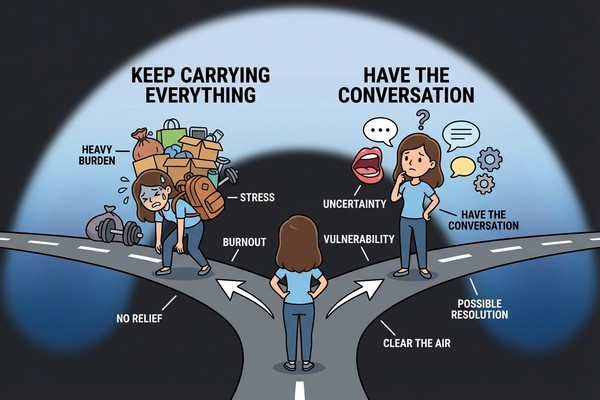
There’s a conversation you’ve been avoiding. Maybe it’s with your partner about who handles the school forms, or with your colleague about project follow-ups, or with your sibling about caring for aging parents. You know something needs to shift, but every time you imagine bringing it up, your stomach tightens. What if they think you’re ungrateful? What if they get defensive? What if nothing changes anyway?
The truth is, most of us would rather carry an impossible load than risk an uncomfortable conversation. We’ve been conditioned to believe that asking for help makes us needy, or that delegating tasks makes us demanding. But here’s what I’ve learned: the conversation you’re avoiding is probably the kindest thing you could do for everyone involved.
Why Handoff Conversations Feel Like Walking Through Fire
The reason these conversations feel so loaded isn’t because we’re asking too much—it’s because we’re asking for something that’s been invisible. When you’ve been the person who remembers everything, your mental work becomes background noise to everyone else. They don’t see the cognitive load of tracking deadlines, anticipating needs, or following up on loose ends. They just see the magical results.
So when you finally speak up, it can feel like you’re asking someone to take on a “new” responsibility that was never really theirs to begin with. But that’s not what’s happening. You’re asking them to see work that was always there, work you’ve been doing quietly in the margins of your life.
The fear isn’t really about their reaction—it’s about finally admitting how much you’ve been carrying. There’s grief in that acknowledgment. Grief for all the mental space you’ve lost, all the times you felt alone in the responsibility, all the resentment that built up while you smiled and said everything was fine.
The Goal Isn’t Perfect Division—It’s Shared Ownership
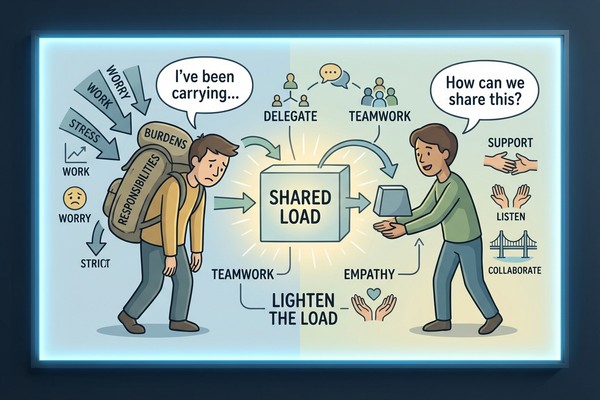
Before you have this conversation, get clear on what you’re actually asking for. You’re not trying to create a perfectly balanced spreadsheet of responsibilities. You’re not trying to prove that you do more work than anyone else. You’re trying to move from solo ownership to shared ownership of outcomes.
This distinction matters because it changes how you approach the conversation. Instead of “You never help with…” you’re saying “I’d like us both to own this together.” Instead of listing everything you do, you’re focusing on one specific area where shared ownership would make the biggest difference.
The goal isn’t to prove you’re overloaded—it’s to create space for someone else to step into ownership alongside you.
Think about the difference between delegating a task and sharing ownership. When you delegate, you’re still the project manager. You assign the work, check on progress, and ultimately remain responsible for the outcome. When you share ownership, you both care about the result. You both notice when something’s off track. You both feel responsible for making it work.
The Script: Name, Impact, Outcome
Here’s a framework that works whether you’re talking to your partner, your colleague, or your family member. It has three parts: name the mental load, describe the impact, and suggest a specific outcome.
Name the load: “I’ve been carrying all the mental work around [specific area]. That means I’m the one tracking deadlines, remembering follow-ups, and making sure nothing falls through the cracks.”
Impact: “It’s taking up a lot of mental space for me, and I find myself feeling resentful when I’m the only one who seems to notice when things aren’t getting done.”
Desired outcome: “I’d love for us to share ownership of this. What would it look like for both of us to feel responsible for making sure this area runs smoothly?”
Notice what this script doesn’t do. It doesn’t list every single thing you do. It doesn’t compare workloads. It doesn’t use accusatory language. It names your experience without making the other person wrong for not seeing it before.
Let’s say you’re talking to your partner about managing your child’s school communication. Instead of “You never read the school emails and I’m tired of being the only one who knows what’s going on,” you might say: “I’ve been handling all the school communication—reading emails, tracking forms, remembering spirit week themes. It’s taking up mental space throughout my day, and I feel like I’m the only one plugged into what’s happening at school. I’d love for us to both feel responsible for staying on top of school stuff. What would that look like?”
Define Done and Set Expectations
Once you’ve had the opening conversation, don’t assume you’re both picturing the same thing. The phrase “help with the school stuff” means different things to different people. To you, it might mean proactively reading every email and flagging important dates. To them, it might mean responding when you ask them to do something specific.
This is where you need to get concrete about what shared ownership actually looks like:
- Who checks the school portal and when?
- How do you share important information with each other?
- What happens when forms need to be filled out?
- Who’s responsible for remembering picture day or early dismissal?
The same applies at work. If you’re sharing ownership of client follow-up, what does that mean? Do you both reach out to different clients? Does one person handle initial contact and the other handles follow-up? How do you track what’s been done and what still needs attention?
Shared ownership without clear agreements just creates confusion and duplicate effort.
This isn’t about creating rigid rules—it’s about making sure you’re both working toward the same definition of success. And here’s the key: you need to agree on how you’ll both stay informed. Shared ownership falls apart when information stays siloed.
Create Visibility Systems
Most handoffs fail because the mental load becomes invisible again. You agree that your partner will handle bedtime routines, but you still find yourself mentally tracking whether teeth got brushed and stories got read. You delegate client follow-up to a colleague, but you’re still wondering if they remembered to send that important email.
The solution isn’t to stop caring—it’s to create systems that make the work visible to both of you. This might look like:
- A shared calendar where both of you add school events and deadlines
- A project management tool where you can both see client communication status
- A simple note-taking app where you capture decisions and next steps
- Weekly check-ins where you both review what’s coming up
The goal isn’t to create more work—it’s to create shared awareness. When you can both see what’s happening, you can both take ownership of outcomes.
The Two-Week Trial
Don’t try to permanently reorganize your entire life in one conversation. Instead, propose a trial period. “Let’s try this for two weeks and then check in about how it’s working.” This takes the pressure off getting everything perfect right away and gives both of you permission to adjust as you learn.
During the trial, resist the urge to micromanage or jump in when things don’t happen exactly how you would do them. The point isn’t to clone your approach—it’s to share the responsibility. If your partner forgets to pack the lunch but remembers to give the kids lunch money, that’s still ownership. If your colleague handles client follow-up differently than you would but clients are happy, that’s success.
After two weeks, have an honest conversation about what worked and what didn’t. Maybe the system needs tweaking. Maybe the division of responsibilities needs adjusting. Maybe you discovered that shared ownership looks different than either of you expected.
The Question That Changes Everything
Here’s the prompt that will help you identify where to start: What handoff would reduce the most resentment in your life right now?
Not the biggest task. Not the most time-consuming responsibility. The one that, when you’re lying awake at 2 AM mentally reviewing your to-do list, makes you feel most alone in the responsibility.
Maybe it’s the constant mental tracking of household supplies. Maybe it’s being the only one who remembers family birthdays. Maybe it’s carrying all the emotional labor of team morale at work. Maybe it’s being the default decision-maker for everything related to your aging parents.
Whatever it is, that’s where you start the conversation.
The handoff conversation isn’t about creating perfect balance—it’s about creating partnership. It’s about moving from “I’ll handle everything” to “we’ll figure this out together.” And sometimes, the kindest thing you can do for the people you care about is give them the chance to truly share the load with you.
The conversation you’ve been avoiding might be the beginning of the support you’ve been craving. But first, you have to be willing to name what you’ve been carrying alone.
This article was created with collaboration between humans and AI—we hope you ❤️ it.