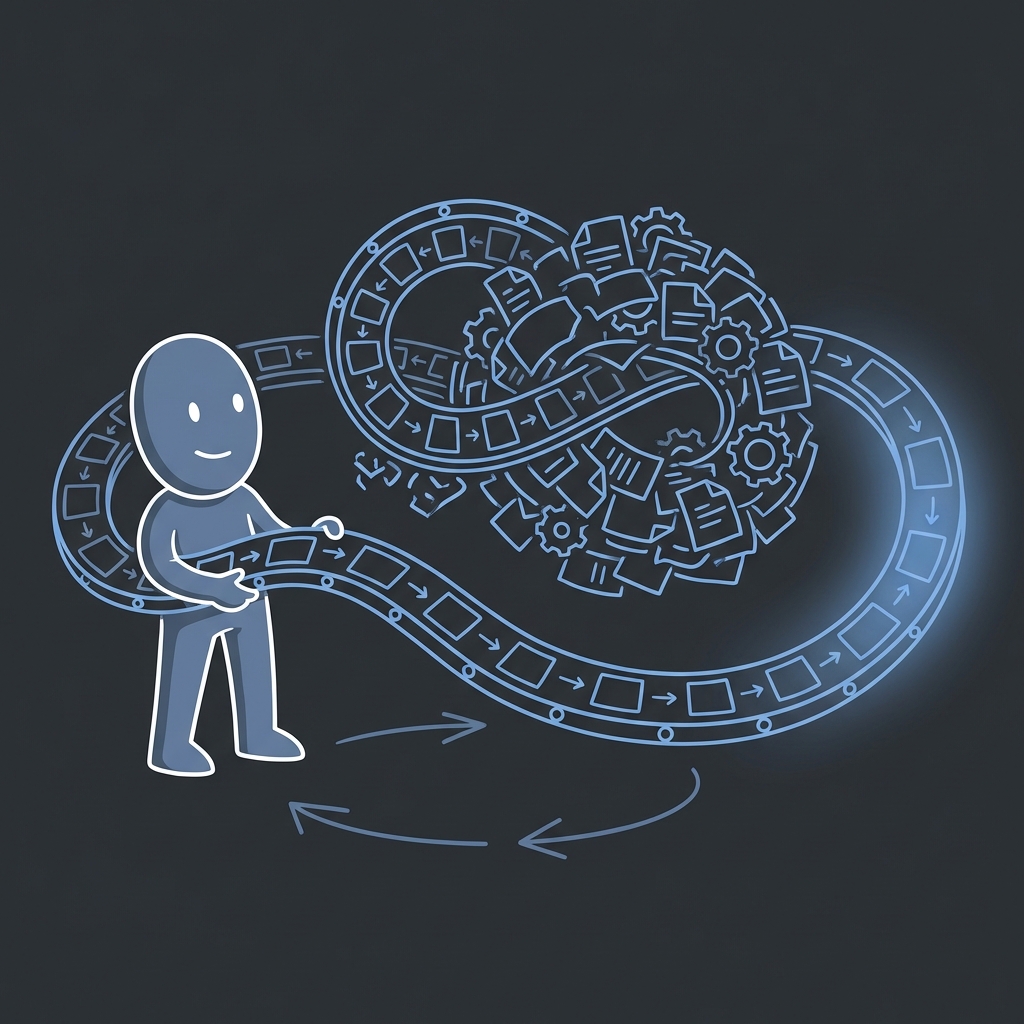
You know that feeling when you finish the dishes, turn around, and there’s already another plate in the sink? Or when you finally get caught up on laundry, only to realize everyone’s wearing clothes that will need washing again tomorrow? That creeping sense that no matter how hard you work, you’re always behind on something.
Here’s what nobody tells you about household work: it’s not supposed to end. Ever. And the reason you feel like you’re failing isn’t because you’re doing something wrong—it’s because you’re measuring regenerative work with the wrong ruler.
Most of us approach household tasks like they’re projects with clear endpoints. Finish the presentation, check. Complete the report, done. But household work doesn’t follow project logic. It follows biological logic, seasonal logic, the relentless logic of entropy itself. The dishes regenerate because people eat. The laundry multiplies because bodies exist in the world. The floors get dirty because life happens on top of them.
The Two Types of Work Nobody Talks About
There are really two kinds of work in your life, though most productivity advice pretends there’s only one. There’s project work—the kind with clear beginnings, middles, and ends. Write the proposal. Plan the vacation. Organize the closet. These tasks have completion states. You can point to them and say “done.”
Then there’s regenerative work—the kind that cycles endlessly, like breathing or seasons. Making meals. Managing relationships. Maintaining your living space. Keeping bodies clean and fed and clothed. This work doesn’t complete; it sustains.
The problem is that our entire productivity culture is built around project work. Every system, every app, every methodology assumes that tasks should move from “to-do” to “done” and stay there. When regenerative work keeps showing up again, these systems read it as failure. The dishes are back on the list again? You must be doing something wrong.
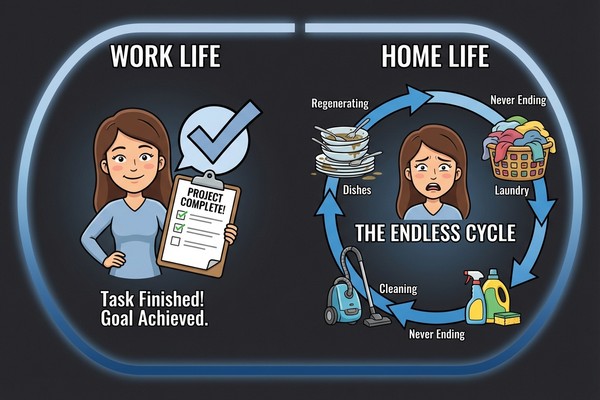
But you’re not doing anything wrong. You’re just trying to manage two fundamentally different types of work with tools designed for only one of them.
Think about it: when did you last feel truly “done” with laundry? Not just caught up for the moment, but actually finished, with no more laundry ever to be done? Never, because that’s not how laundry works. Laundry is a river, not a lake. It flows through your life continuously, and your job isn’t to stop the river—it’s to manage the flow.
Why “Getting Ahead” Is a Myth
The regenerative nature of household work explains why you can spend an entire Saturday cleaning and organizing, only to feel behind again by Tuesday. It’s not because you didn’t work hard enough or because your family is particularly messy (though they might be). It’s because you accomplished exactly what regenerative work is supposed to accomplish: you maintained the system for a few more days.
The goal isn’t to finish the dishes forever. The goal is to keep the kitchen functional.
This reframe changes everything. Instead of measuring success by completion, you measure it by sustainability. Instead of asking “Am I done?” you ask “Is this working?” Instead of trying to get ahead of the cycle, you try to find a rhythm that doesn’t exhaust you.
Most people I know are carrying around a low-level anxiety about their household backlog. There’s always something that needs doing, something that’s been put off, something that’s piling up. But what if that feeling of “behind-ness” isn’t a problem to solve but a signal to recalibrate?
What if the real issue isn’t that you can’t keep up, but that you’re trying to keep up with something that’s designed to be infinite?
The Steady-State Solution
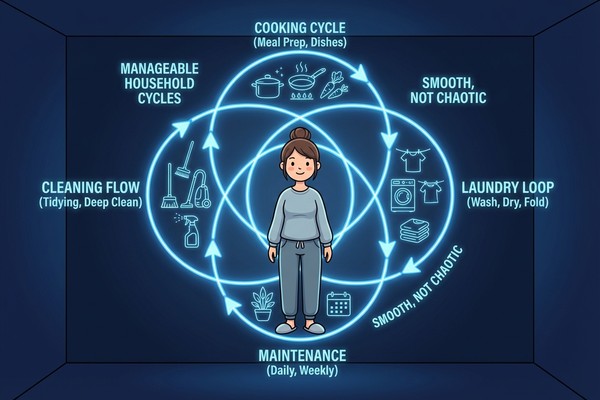
Once you accept that regenerative work never ends, you can start optimizing for the right thing: steady state instead of completion. Steady state means the system runs smoothly without constant crisis intervention. It means clean dishes are usually available when you need them, not that the dishwasher is always empty. It means laundry flows through the house at a manageable pace, not that every piece of clothing is always clean and put away.
Steady state is about rhythm, not perfection. It’s about finding the minimum viable frequency for each regenerative task—how often do you actually need to vacuum to maintain the standard of cleanliness that works for your life? How much meal prep actually reduces your daily stress versus creating more work upfront?
The beauty of thinking in steady state is that it gives you permission to stop chasing the myth of “caught up.” You’ll never be caught up on regenerative work because there’s no such thing. But you can absolutely find a sustainable rhythm that keeps your household functioning without burning you out.
Small Shifts, Big Relief
The practical implications of this shift are surprisingly liberating. Instead of trying to eliminate regenerative work (impossible), you can focus on reducing the mental load it creates. Here are the approaches that actually work:
Defaults over decisions: The more you can systematize regenerative work, the less mental energy it consumes. Meal planning, automatic grocery delivery, designated laundry days—these aren’t about efficiency, they’re about reducing the number of micro-decisions you have to make every day.
Handoffs that stick: Look for places where you can truly transfer ownership of a regenerative cycle to someone else, not just delegate individual tasks. The person who manages dinners owns the whole cycle: planning, shopping, cooking, cleanup. This prevents the coordination work from bouncing back to you.
Strategic automation: Not every task needs to be automated, but the ones that create the most mental friction are worth the investment. Dishwashers, robot vacuums, automatic bill pay—these tools don’t just save time, they save the cognitive work of remembering and scheduling.
The key is identifying which regenerative cycles create the most stress for you personally. Maybe it’s the daily question of “what’s for dinner?” Maybe it’s the visual chaos of clutter that never seems to stay organized. Maybe it’s the administrative work of managing everyone’s schedules and appointments.
You can’t eliminate regenerative work, but you can absolutely reduce how much mental space it occupies.
What’s Cycling in Your Life Right Now?
Take a moment to look around your life—not just your house, but your whole life—and identify what’s regenerative versus what’s project-based. The work emails that require daily attention. The relationships that need regular nurturing. The car that needs periodic maintenance. The garden that grows whether you’re paying attention or not.
Notice how much of your mental load is actually regenerative work that you’ve been treating like projects. Notice how often you’ve felt “behind” on things that don’t actually have finish lines.
This isn’t about lowering your standards or accepting chaos. It’s about rightsizing your expectations to match reality. It’s about designing systems that work with the cyclical nature of life instead of fighting against it.
Most productivity advice tries to help you do more, faster, better. But what if the real solution isn’t optimization—it’s recognition? Recognition that some work is meant to cycle. Recognition that steady state is an achievement, not a consolation prize. Recognition that the feeling of “never being done” might not be a personal failing but a fundamental misunderstanding of what you’re trying to accomplish.
The household backlog isn’t a problem to solve once and for all. It’s a system to manage, a rhythm to find, a flow to direct rather than stop. And once you stop trying to empty the ocean with a bucket, you might find that managing the tides is actually quite doable.
This article was created with collaboration between humans and AI—we hope you ❤️ it.