You know that feeling when you’re physically present but mentally scattered across seventeen different concerns? When your child is telling you about their day, but part of your brain is cataloging what needs to happen before dinner, and another part is wondering if you remembered to respond to that work email?
We’ve been sold the idea that productivity is the answer—that if we just optimize our systems and squeeze more efficiency out of our days, we’ll somehow arrive at peace. But here’s what I’ve noticed: the most productive people I know are often the most anxious. They’ve gotten really good at doing things, but they’ve lost the ability to simply be.
What most of us actually want isn’t more output. It’s more presence. We want to show up fully for the moments that matter. We want to feel like we’re actually living our lives instead of just managing them.
The Real Goal Hiding Behind Our Productivity Obsession
When someone says they want to be more organized or productive, listen to what they’re really describing. “I want to be present when my kids are talking to me.” “I want to enjoy dinner without my mind racing through tomorrow’s to-do list.” “I want to have conversations where I’m actually listening, not planning my response while thinking about three other things.”
The goal was never efficiency. The goal was always presence.
But presence feels impossible when your mental bandwidth is consumed by the endless work of remembering, tracking, and anticipating. When you’re the person who holds all the details—who knows which kid has the dentist appointment, which project deadline is looming, which bill needs paying—your attention gets fragmented into a thousand tiny pieces.
The productivity industry wants you to believe that better systems will solve this. But most productivity advice actually makes the problem worse by giving you more things to track, more methods to maintain, more mental overhead disguised as solutions.
Where Do You Feel Absent Lately?
Let’s try something different. Instead of asking what you need to get done, ask yourself: where do you feel absent in your own life?
Maybe it’s during bedtime stories, when you’re physically there but mentally reviewing tomorrow’s meetings. Maybe it’s in conversations with your partner, where you find yourself half-listening while mentally coordinating schedules. Maybe it’s during meals, when you’re eating but not tasting, present but not experiencing.
I notice my own absence most acutely in transitions—those small moments between activities when I could pause and breathe, but instead I’m already mentally three steps ahead. Walking from the car to the house while planning dinner. Sitting down at my desk but immediately opening twelve tabs instead of taking a moment to settle in.
These moments of absence aren’t character flaws. They’re symptoms of a mind that’s been trained to always be “on,” always managing, always anticipating the next thing that needs attention.
The Loads That Steal Presence
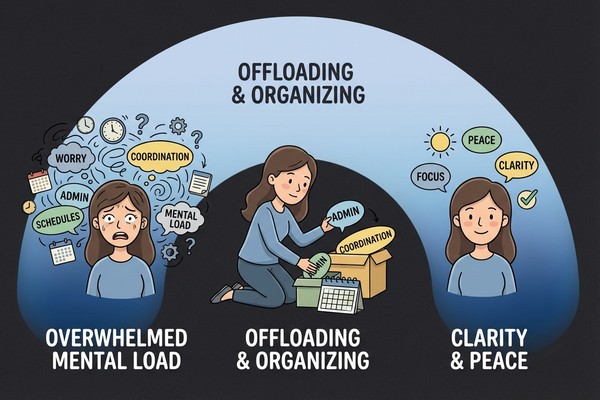
When I work with people who feel chronically scattered, we usually find three main categories of mental load that fragment their attention:
Worry load: The anxious mental rehearsal of future scenarios. What if this goes wrong? What if I forget that thing? What if I’m not prepared? This kind of thinking masquerades as preparation, but it’s actually just anxiety wearing a productivity costume.
Admin load: The endless small tasks that accumulate in the corners of your mind. Scheduling appointments, responding to emails, updating calendars, paying bills. Each task might only take five minutes, but collectively they create a constant background hum of “things I need to handle.”
Coordination load: The invisible work of being the person who knows where everyone needs to be and when. Who’s picking up whom, what needs to happen before the event, which items need to be packed. This is often the heaviest load because it never really ends—as soon as you handle one coordination challenge, another one appears.
Your attention is not broken. It’s just carrying too much.
The solution isn’t to get better at juggling all these loads. The solution is to recognize that some of these loads don’t actually need to be carried by you, and others don’t need to be carried at all.
Choose One Presence Moment to Protect
Here’s a small but powerful exercise: choose one recurring moment in your week where you want to be more present. Not five moments—just one. Maybe it’s the first ten minutes after you get home from work. Maybe it’s breakfast with your family. Maybe it’s your evening walk or the few minutes before you fall asleep.
Now, instead of trying to force yourself to be more present in that moment, work backward: what would need to be different for you to naturally show up more fully?
If you want to be present during breakfast, maybe that means handling the day’s coordination the night before, so your morning mind isn’t immediately pulled into logistics. If you want to be present during bedtime stories, maybe that means creating a small ritual that helps you transition from “day mode” to “evening mode.”
The point isn’t to add another item to your optimization list. The point is to recognize that presence isn’t something you achieve through willpower—it emerges when the conditions are right.
Pick One Load to Reduce or Hand Off
Now for the practical part: look at those three categories of mental load and identify one specific load you could reduce or hand off this week.
Maybe it’s setting up automatic bill pay so you stop carrying the mental reminder of due dates. Maybe it’s having a conversation with your partner about sharing the coordination load for weekend activities. Maybe it’s accepting that you don’t actually need to mentally rehearse every possible scenario for next week’s presentation.
The goal isn’t to optimize your way to perfection. The goal is to create a little more space in your mental bandwidth so that when you choose to be present, you actually can be.
A Tiny Ritual: The 2-Minute Arrival Practice
Here’s something that has helped me transition from the scattered energy of managing tasks to the settled energy of being present: a two-minute arrival practice.
Whenever you’re about to engage in something that matters to you—a conversation, a meal, time with your kids, even sitting down to work on something you care about—take two minutes to actually arrive.
Put down your phone. Take three deep breaths. Notice where you are physically. Acknowledge what you’re about to do and why it matters to you. That’s it.
Presence isn’t a destination you reach through productivity. It’s a choice you make in each moment.
This isn’t meditation or mindfulness in the formal sense. It’s just the simple act of showing up to your own life. Most of us are so accustomed to moving from task to task without pause that we forget we can choose to arrive fully to the moments we’re already in.
The Permission to Hold Less
The productivity world will tell you that the answer is better systems, smarter workflows, more efficient habits. But what if the answer is simpler than that? What if the answer is just… holding less?
What if you don’t need to remember everything, track everything, optimize everything? What if some of the load you’re carrying isn’t actually yours to carry? What if some of the worry you’re doing isn’t actually useful?
I’m not suggesting you become irresponsible or stop caring about the things that matter. I’m suggesting that you might be carrying more than your fair share, worrying about more than you can control, and managing more than actually needs to be managed.
The most present people I know aren’t the ones who have perfected their systems. They’re the ones who have gotten clear about what deserves their attention and what doesn’t. They’ve learned to distinguish between necessary mental load and optional mental load. They’ve given themselves permission to let some things go.
Your presence is not a productivity hack. It’s not something you achieve by doing more or doing better. It’s something you reclaim by holding less, carrying less, managing less. It’s something you return to by remembering that your attention is not a resource to be optimized—it’s a gift to be offered.
---
If this resonates with you, you might be interested in Backlit—an AI assistant designed specifically to help reduce mental load by taking ownership of remembering, tracking, and following up on tasks. Unlike other productivity tools that just organize your work, Backlit actually holds the load so you don’t have to. Join our waitlist and try our starter app to begin logging the mental loads that are fragmenting your presence.
This article was created with collaboration between humans and AI—we hope you ❤️ it.