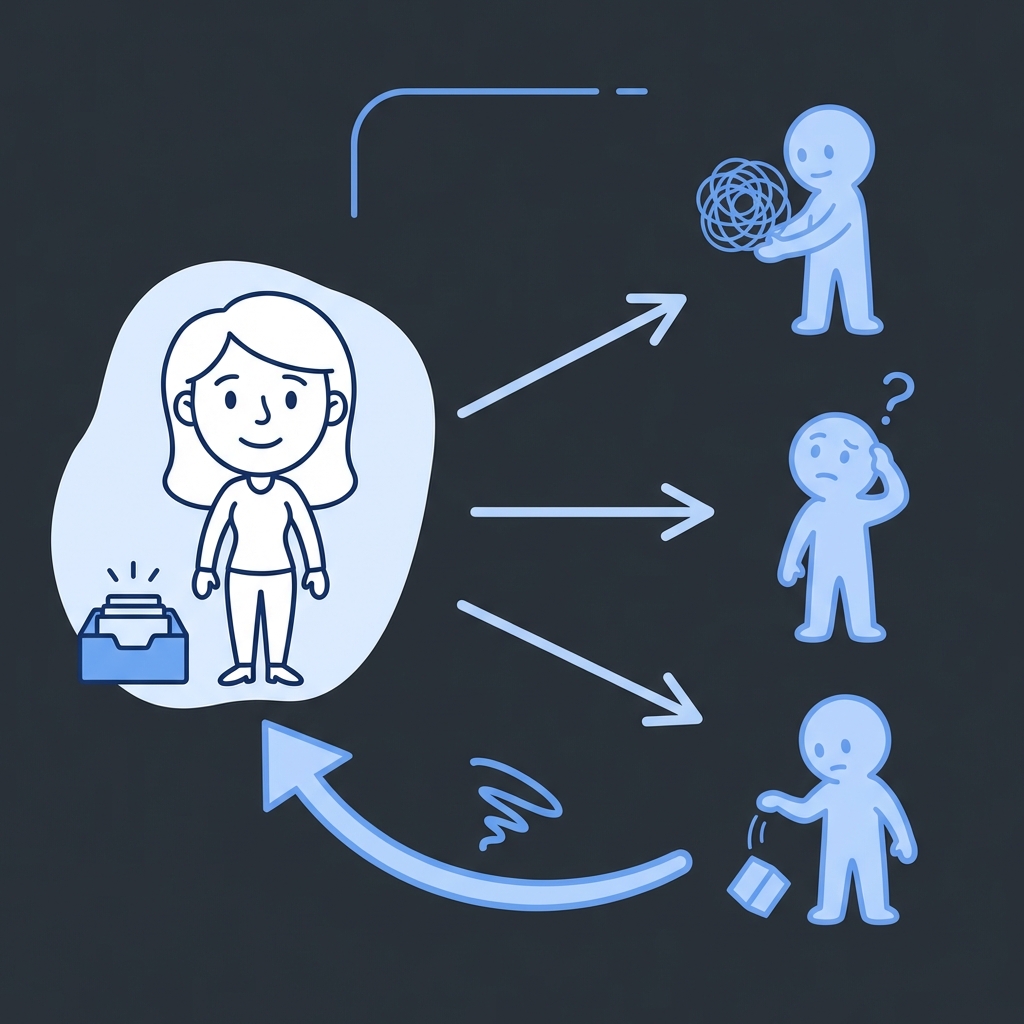
You finally decide to delegate that project that’s been eating your brain space for weeks. You hand it off, feel a momentary wave of relief, then spend the next three days mentally tracking whether it’s getting done, wondering if you explained it clearly enough, and calculating when you should check in without seeming like a micromanager.
Sound familiar? You’re not alone. Most of us have been sold a bill of goods about delegation—that it’s some magical productivity hack that instantly lightens your mental load. But here’s what actually happens: you delegate the doing while accidentally keeping all the thinking.
Real delegation isn’t about getting tasks off your plate. It’s about getting them out of your head entirely. And that’s a much harder thing to pull off than productivity culture wants to admit.
The Difference Between Assigning and Offloading
When most people say “delegate,” they really mean “assign.” They’re handing over the execution while maintaining ownership of everything else—the planning, the standards, the timeline, the quality control, and the endless mental ping of wondering how it’s going.
True offloading means the entire responsibility transfers. Not just the work, but the worry. Not just the doing, but the remembering to check if it got done. When you successfully offload something, you genuinely forget about it until it naturally resurfaces through normal channels.
Think about the last time you asked someone to “handle the grocery shopping.” Did you stop thinking about groceries? Or did you find yourself mentally inventorying what might be running low, wondering if they’d remember the specific brand you prefer, calculating whether they’d go before you ran out of milk?

The coordination work—all that invisible cognitive labor of managing the handoff—often weighs more than the original task. You’ve successfully delegated yourself into a management role you never wanted.
The Coordination Layers That Stick
Every delegation attempt carries hidden coordination costs that somehow always seem to land back on your plate. There’s the scope definition layer: making sure both of you understand exactly what needs to happen. There’s the standards layer: communicating your expectations without sounding controlling. There’s the timing layer: when it needs to start, when it needs to finish, and all the dependencies in between.
Then there’s the handoff layer—arguably the stickiest of all. Even when someone completes a task beautifully, you still need to know it’s done, verify it meets your needs, and integrate it back into your larger system. Each of these coordination points creates a mental bookmark that keeps the task partially yours.
Consider asking your partner to “plan date night.” Sounds simple enough. But then you find yourself wondering: Are they thinking about it? Should I suggest restaurants or let them surprise me? What if they pick somewhere I can’t eat? When will they make the reservation? Should I check if they need the babysitter’s number?
The coordination layers always seem to find their way back to the person who cares most about the outcome.
You delegated date night planning, but you kept date night worrying. The mental load didn’t transfer—it multiplied.
Why “Just Tell Me What to Do” Keeps You Managing
Here’s a phrase that sounds helpful but actually creates more work: “Just tell me what to do.” It seems like someone offering to take things off your plate. In reality, they’re asking you to become their project manager.
When someone says “just tell me what to do,” they’re requesting step-by-step instructions, timeline management, and quality oversight. They want to help with the execution while leaving you responsible for all the cognitive work. You become the brain while they become the hands.
This dynamic is exhausting because it requires you to think through the entire process in advance, break it down into manageable pieces, communicate it clearly, and then monitor progress. It’s often more mental work than doing the thing yourself.
The person offering to help isn’t being malicious. They might genuinely want to lighten your load. But they’re asking you to transform your organic, intuitive understanding of a task into a formal management system. That transformation is work—invisible, uncompensated cognitive work.
The Verification Tax
Even when delegation goes smoothly, there’s usually a verification tax at the end. You need to confirm the task was completed, check that it meets your standards, and mentally close the loop. This final step often gets overlooked in delegation advice, but it’s where a lot of mental load sneaks back in.
The verification tax shows up in different ways. Sometimes it’s literal checking—reviewing their work to make sure it’s right. Sometimes it’s emotional labor—managing your own anxiety about whether it got done properly. Sometimes it’s administrative overhead—updating your own systems to reflect the completed task.
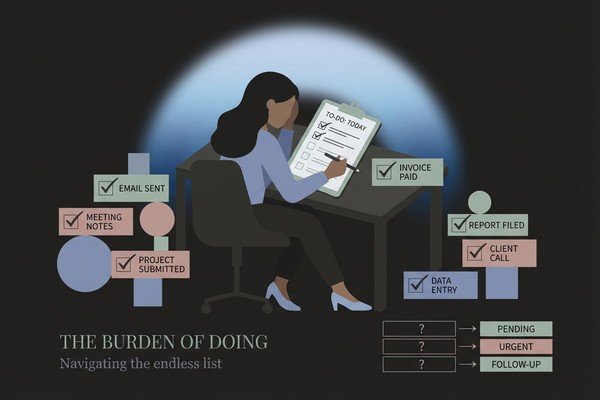
You might delegate bill paying to your partner, but you still need to know which bills got paid, when, and for how much. You might ask your teenager to clean their room, but you still need to verify it happened and meets basic livability standards. The task gets done, but the mental accounting stays with you.
This is why some people eventually stop delegating altogether. The overhead of managing delegation feels heavier than just doing everything themselves. They’re not wrong—bad delegation really is more work than no delegation.
How to Delegate Outcomes, Not Steps
Effective delegation requires flipping the script entirely. Instead of delegating tasks while keeping outcomes, you delegate outcomes while releasing tasks. You define what success looks like and let the other person figure out how to get there.
Outcome delegation sounds like: “I need our household to never run out of milk” instead of “Please buy milk when we’re running low.” It sounds like: “I need our client to feel confident about this project” instead of “Please send them a status update by Friday.”
When you delegate outcomes, you’re transferring ownership of both the result and the method. The other person gets to develop their own system, their own timeline, their own quality standards—as long as they deliver the outcome you need.
This approach requires more trust upfront but creates less ongoing management. You’re not responsible for monitoring their process because you’ve only committed to evaluating their results. The mental load of figuring out how to achieve the outcome transfers along with the work itself.
It also allows for solutions you might never have considered. When you delegate the outcome “never run out of milk,” someone might set up automatic grocery delivery, buy a mini-fridge for backup, or negotiate with the neighbor to share bulk purchases. You get your outcome plus the bonus of not having to invent the solution yourself.
The Simple Test: Did I Stop Thinking About It?
Here’s the most honest way to evaluate whether delegation actually reduced your mental load: Did you stop thinking about it afterward? Not “did it get done” or “was I happy with the results,” but genuinely—did it leave your mental space?
If you found yourself checking in, wondering about progress, or mentally rehearsing follow-up conversations, the delegation didn’t work. You successfully distributed the labor while keeping the worry. The task got done, but your mental load stayed the same or even increased.
Real delegation is measured by what disappears from your thoughts, not what appears on someone else’s to-do list.
This test reveals why so much well-intentioned delegation fails. People focus on task completion rather than mental load transfer. They measure success by whether the thing got done, not by whether they stopped carrying it in their head.
When delegation truly works, you’re genuinely surprised when the outcome appears. Someone mentions that the bills are paid, and you think “oh right, I forgot that was happening this month.” The groceries show up, and you realize you haven’t thought about food shopping in weeks. The project gets completed, and you’re delighted rather than relieved because you’d actually forgotten it was in progress.
Systems That Own the Follow-Up
The most effective delegation happens when you can hand off not just the task, but the entire system around it. This means finding or creating mechanisms that handle the follow-up, the verification, the coordination—all the sticky bits that usually bounce back to you.
Sometimes this looks like recurring calendar events that prompt action without your involvement. Sometimes it’s automated systems that handle the monitoring and reporting. Sometimes it’s simply establishing clear communication protocols so you know when something needs your attention versus when it’s handled.
The goal is creating delegation that doesn’t require you to remember that you delegated. The system itself carries the responsibility for tracking, following up, and completing the loop. You become a recipient of outcomes rather than a manager of processes.
This is why effective delegation often requires some upfront investment in systems and communication. You’re not just handing off a task—you’re creating a sustainable structure that can handle similar tasks in the future without your ongoing cognitive involvement.
When delegation works this well, it doesn’t just reduce your current mental load. It prevents future mental load from accumulating. You’ve successfully moved something from your internal management system to an external one that operates independently of your attention and memory.
That’s the difference between delegation that helps and delegation that just redistributes the burden. One frees your mind. The other keeps you employed as an unpaid project manager for your own life.
This article was created with collaboration between humans and AI—we hope you ❤️ it.